国际政治
世界上最具影响力的敌友关系国家谈论核武器
中文译文
这篇报道刊登在《今日解读》这份每日新闻简报中,旨在帮助读者理解当日最值得关注的新闻与故事。点击此处订阅。
唐纳德·特朗普总统在结束了为期四天的亚洲之行后正返回美国。此行期间,他有幸欣赏到一场别出心裁的《Y.M.C.A.》翻唱表演,对一位臭名昭著的窃国者大加赞扬,还发表了一些诚挚——尽管略显尴尬——的关于总统间友谊的宣言。
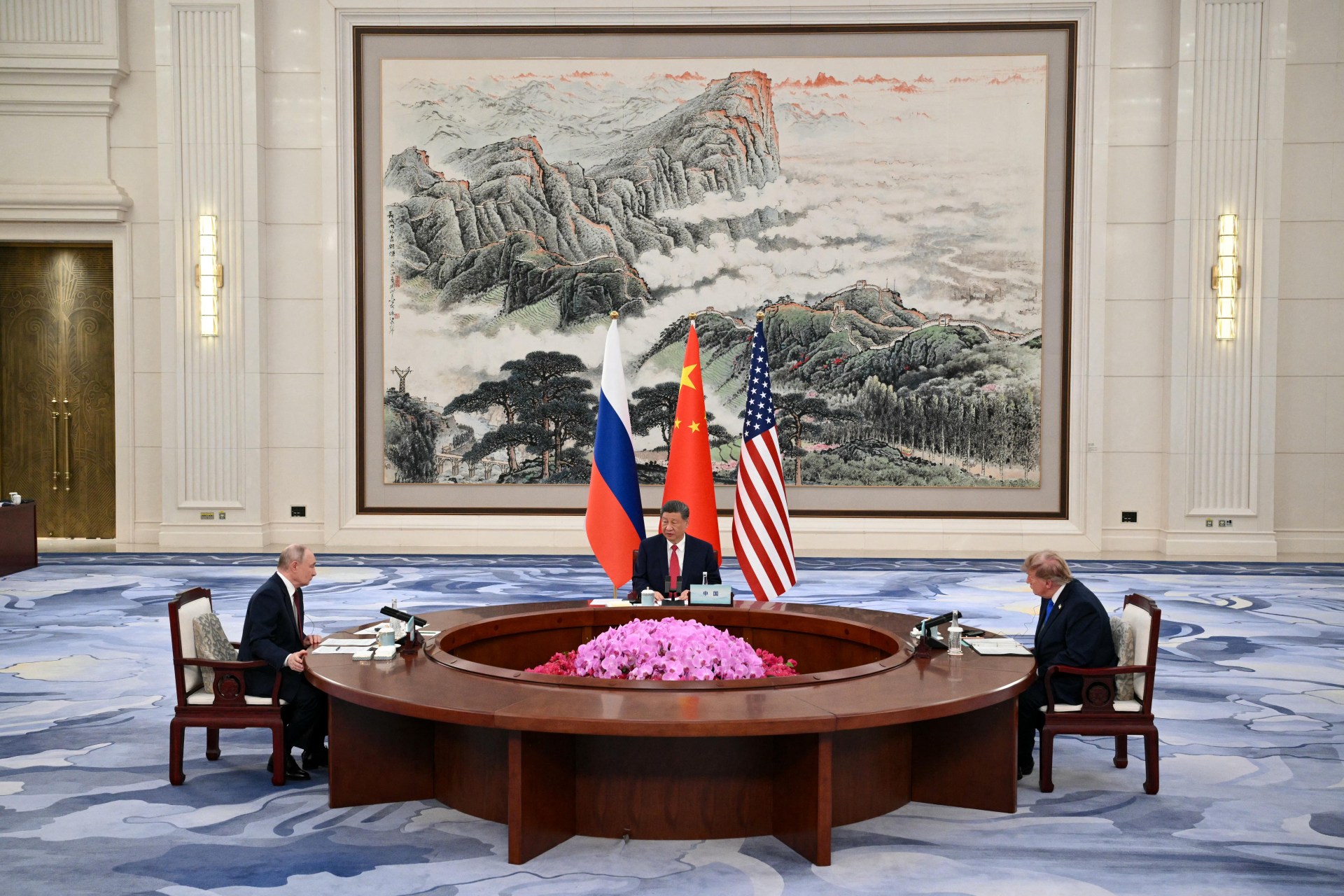
不过,此次出行的亮点无疑是特朗普与中国国家主席习近平以及俄罗斯总统弗拉基米尔·普京举行的史无前例的三方会晤,这是三国领导人首次会面。
三位领导人围坐在一张巨大且反光的圆桌旁,讨论了改革联合国、增加全球石油供应以及降低核战争风险等议题。所幸的是,他们一致认为核战争绝非明智之举。美俄之间的一项重要核条约在九个月前到期,而中国则是谈判新条约时的一个障碍。事实上,这三个国家在某种程度上都是彼此地缘政治野心的重要阻碍。
因此,他们在长达一小时的会谈中并未取得任何突破。但他们同意继续对话……包括讨论核扩散问题。
进一步了解
令我惊讶的是,目前俄美之间并没有核军控条约。自20世纪70年代初以来,两国通过一系列军控协议同意对各自的核武器数量进行限制。但当最新的协议在2月份到期后,却没有任何新的协议取而代之。(尽管特朗普多年来一直倡导核裁军。)我们究竟是如何走到这一步的?为了解开这个谜团,我联系了《新战略武器削减条约》——也就是最近到期的美俄核武器协议——的首席谈判代表罗斯·戈特莫勒。
最初的《战略武器削减条约》于1991年签署,就在苏联解体之前。这是两国首次不仅同意停止增加核武器数量,还决定主动削减战略武器。
戈特莫勒表示,《新战略武器削减条约》进一步减少了两国的核武器库存:导弹数量降至700枚,发射装置降至800套,部署的弹头数量降至1,550枚。(考虑到冷战高峰时期全球的核弹头数量约为70,000枚,这一成就可谓相当显著。)
不过,《新战略武器削减条约》是在奥巴马时代核武器控制领域短暂而美好的乐观时期谈判达成的。随后俄罗斯开始在乌克兰采取侵略行为,这种乐观情绪便消失了。该条约曾在2021年延长过一次,那是在普京开始全面入侵前大约一年。从那以后,两国都并未表现出积极的外交态度。相反,特朗普和普京都曾暗示他们对核武器可能有些兴趣。
当然,好消息是两位总统都未曾将这种兴趣付诸行动。事实上,今年《新削减战略武器条约》的到期也并未引发核武器数量的增加。“目前俄罗斯和美国仍维持着现有的限制水平,”戈特莫勒对Vox表示。
坏消息是,任何一方都可能改变立场,而且未来要谈判更严格的限制措施还存在诸多复杂因素。其中一个重要因素就是中国,它正在迅速扩充自己的核武器库——这也就使得俄罗斯和美国缺乏进一步削减核武器的动力。这就是今天上午三方会议的相关背景。在进入闭门会议之前,特朗普明确谈到了核武器控制问题。而戈特莫勒则表示,她“希望”此次峰会能“成为与俄罗斯人展开新谈判的催化剂,同时也为与中国人进行首次谈判打开大门”。
这一切还有待观察。不过,三位领导人确实发表了一份含糊的峰会后声明,重申“核战争无法取胜,绝不能发动”。重要的是,这一表述呼应了1985年美俄领导人曾在一次重振核武器控制谈判的峰会后发表的声明。
留作后续参考的链接➨ 与更多陌生人交谈。那些偶尔会让人尴尬,但最终能带来积极感受的闲聊,有助于你感受到与他人的联系。根据堪萨斯大学的研究员杰弗里·霍尔的说法,这也有益于整个社区的发展。霍尔表示:“通过给予他人尊严……并让自己走出熟悉的人际圈子,你实际上是在为所有人创造一个更健康的环境。”
出发前……
你知道吗……几乎有15%的成年人患有耳鸣——一种持续存在的、通常是嗡嗡作响的声音?人们曾认为耳鸣是心因性的,但新的研究表明,它是由一种特定类型的听力损伤引起的。
今日小知识:哪种流行的疗法受到了佛教的影响?(你可以在Vox的每日填字游戏中找到这个及其他脑筋急转弯的答案,明天的版面中有解答。)昨天的小知识:昨天我们询问了在1999年女足世界杯上踢进制胜点球的美国足球运动员的名字。那就是布兰迪·查斯泰因,她因庆祝而跪倒在地并撕下球衣,这一举动堪称经典!
原文
This story appeared in Today, Explained, a daily newsletter that helps you understand the most compelling news and stories of the day. Subscribe here.
President Donald Trump is on his way back from China after a four-day Asia trip that included taking in a surreal cover of “Y.M.C.A.,” heaping praise on a noted kleptocrat, and making earnest — if slightly cringe! — declarations of star-crossed presidential friendship.
But the highlight of the trip was surely Trump’s unprecedented trilateral meeting with Chinese President Xi Jinping and Russian President Vladimir Putin, the first between those countries’ leaders.
The three men sat around a comically large and reflective roundtable to discuss issues like reforming the United Nations, increasing the world’s supply of petroleum, and reducing the risk of nuclear war, which they all thankfully agree would be a bad idea.
A major nuclear treaty between the US and Russia lapsed nine months ago, and China has been a sticking point to negotiating a new one. In fact, all three countries are — in one realm or another — major obstacles to each other’s geopolitical ambitions.
Accordingly, no breakthroughs were reached during their hour-long chat. But they did agree to keep chatting…including about nuclear proliferation.
Go a little deeper
I was surprised to learn that there’s currently no nuclear arms control treaty between Russia and the US. The two countries had agreed to mutual limits on their nuclear arsenals under a series of arms-control agreements dating back to the early 1970s. But when the latest one lapsed in February, nothing replaced it. (This despite Trump’s decades-long enthusiasm for nuclear disarmament.)
How, exactly, did we get here? To find out, I reached out to Rose Gottemoeller, the chief negotiator of the New Strategic Arms Reduction Treaty, or New START — that US-Russia nuclear deal that just recently expired.
The original START was signed in 1991, just before the collapse of the Soviet Union. For the first time, the two countries agreed not just to stop growing their nuclear arsenals, but to actively reduce their strategic weapons.
New START slashed their stockpiles even further: to 700 missiles, 800 launchers, and 1,550 deployed warheads, Gottemoeller said. (When you consider that the world had roughly 70,000 nuclear warheads at the peak of the Cold War, it’s a pretty massive accomplishment.)
But New START was negotiated during a brief, shining, Obama-era moment of optimism for nuclear arms control. Then Russia started getting grabby in Ukraine, and that optimism curdled.
The treaty was extended once, in 2021, about a year before Putin began a full-scale invasion. Since then, neither country has been in a particularly diplomatic mood. On the contrary, both Trump and Putin have at times signaled they might be a little nuke-curious.
The good news, of course, is that neither president ever acted on that curiosity. And in fact, the lapse of New START earlier this year hasn’t triggered a buildup. “So far Russia and the United States are sticking with the status quo limits,” Gottemoeller told Vox.
The bad news is that either country could reverse course, and there are complications to negotiating firmer limits in the future. One of the biggies is China, which is rapidly building up its own nuclear stockpile — and thus disincentivizing Russia and the US from cutting theirs back further.
That’s the context for this morning’s trilateral, where Trump spoke explicitly about nuclear arms control before heading into the closed-door meeting. Gottemoeller, for her part, said she was “hopeful” the summit would “be a catalyst for new talks with the Russians [and] also nudge open the door to first talks with the Chinese.”
We’ll have to wait and see about all that. But the three leaders did release a vague post-summit statement that reaffirmed “a nuclear war cannot be won and must never be fought.” That, crucially, is a callback to a statement that US and Russian leaders released in 1985 after a summit that reinvigorated nuclear arms-control talks.
One link for later
➨ Talk to more strangers. That occasionally awkward but ultimately life-affirming small talk helps you feel connected to other people. And according to University of Kansas researcher Jeffrey Hall, it boosts your entire community, too. By offering “dignity to another person...and by stretching yourself outside just the people you know well, you’re actually building a healthier environment for all of us,” Hall says.
Before you go…
Did you know…that almost 15 percent of adults suffer from tinnitus — a persistent, often ringing sound in their heads? It was once believed to be psychosomatic, but new research suggests it’s the result of a very specific type of hearing damage.
Today’s trivia: Which popular therapy method was influenced by Buddhism? (You can find this and other brain puzzles in Vox’s daily crossword. Look for the answer in tomorrow’s edition.)
Yesterday’s trivia: Yesterday we asked you for the name of the US soccer player who scored the game-winning penalty kick at the 1999 Women’s World Cup. That would be Brandi Chastain, who famously — iconically! — fell to her knees and tore her jersey off in celebration.