国际政治代表报道
联合国气候谈判因在化石燃料问题上的严重分歧而破裂
中文译文
土耳其安塔利亚(美联社)——由于在是否提及导致全球变暖的化石燃料问题上存在分歧,联合国气候谈判在周日未能达成总体协议。
在土耳其举行的为期两周的谈判开始前,人们的期望本来就不高,但在是否明确提及化石燃料以及其他问题,包括资金问题上的僵局最终无法调和。
尽管名为COP31的谈判未能达成所谓的框架性决议,但各方在一些较小问题上已取得进展。
阅读更多:各国为应对日益严重的全球变暖而展开激烈讨论,气候谈判进入加时阶段这一切都发生在全球变暖加速、热浪、洪水、风暴和干旱愈发严重的背景下。联合国表示,世界很快就会突破2015年《巴黎气候协定》设定的升温阈值,这一情况现已不可避免。此外,伊朗战争还引发了全球能源危机。更甚的是,强烈的厄尔尼诺现象加剧了人为造成的变暖,并导致了更多天气灾害。
在谈判中通过的任何协议都需要近乎全票的共识。多个国家以及由27个国家组成的欧盟表示,他们无法接受土耳其和澳大利亚联合提出的最终方案,因为该方案未提及化石燃料。虽然最终未能达成协议,但仍有相当多的国家勉强接受了这一决定,认为就某事达成共识更为重要。俄罗斯和沙特阿拉伯则试图将化石燃料排除在文件之外。“我们有一项气候法案却未提及化石燃料,这实在不合理,”爱尔兰气候部长达拉格·奥布莱恩在土耳其安塔利亚举行的气候谈判中代表欧盟发言时说道。这些谈判已经持续了近48小时。
协议草案陷入僵局
智库E3G的阿尔登·迈耶表示,此前25多年来,COP的最终决议中从未提及化石燃料。三年前,在石油资源丰富的阿拉伯联合酋长国,一项具有开创性的协议呼吁“逐步摆脱对化石燃料的依赖”,但从那以后再未明确提及化石燃料。土耳其和澳大利亚提出的方案完全沿用了迪拜协议的内容,但这并不足以让许多国家和环保组织满意。加剧分歧的是,草案中包含了针对工业污染企业的碳捕获与封存相关明确条款及目标,许多国家和活动人士认为这会削弱减少整体排放的努力。
“此次气候大会未能达成具有雄心、公平且基于科学的结果,这完全要归咎于富裕国家、石油输出国,以及土耳其和澳大利亚两位极其无能的大会主席,”忧思科学家联盟的雷切尔·克利图斯说道。
阅读更多:随着草案中未提及化石燃料,活动人士和领导人批评COP31气候谈判
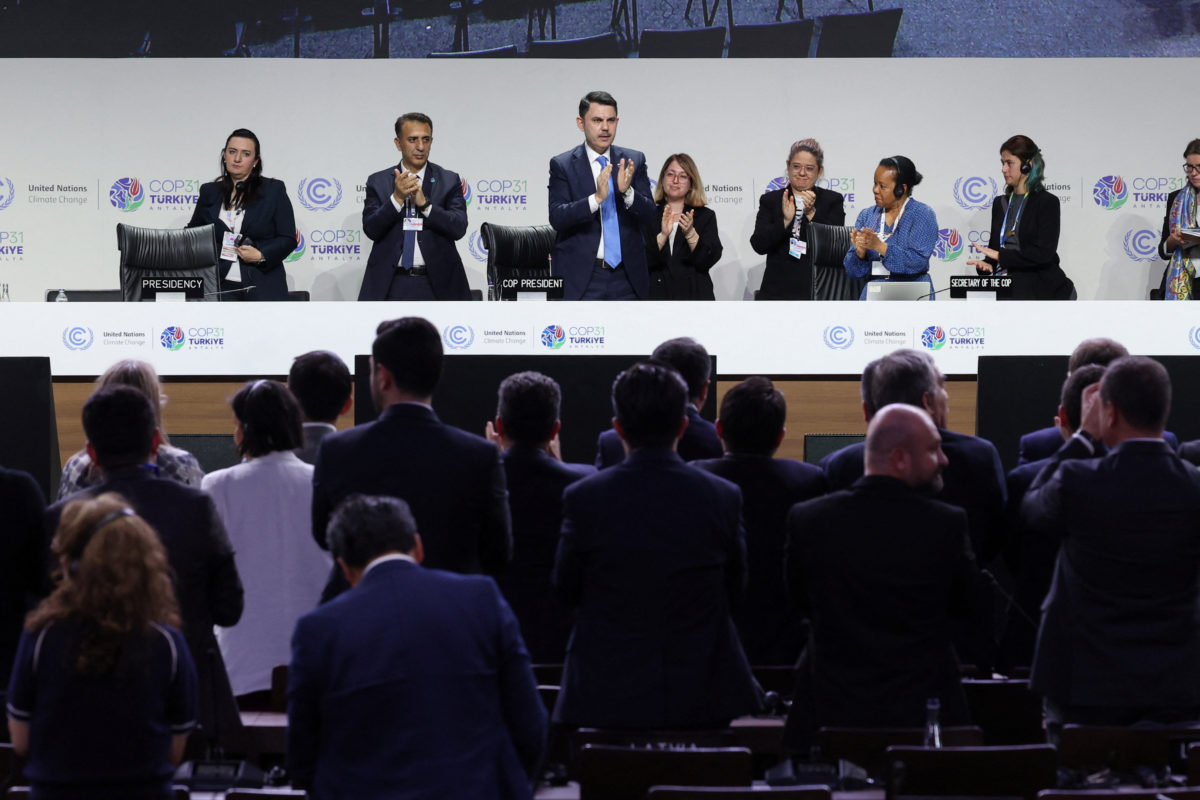
在全体会议中,拟议中的协议宣告失败,而作为COP31主席的土耳其环境部长穆拉特·库鲁姆并未出席,最终由阿塞拜疆的埃尔钦·阿拉赫韦尔迪耶夫宣布了这一失败结果。“遗憾的是,我们未能就相关决议达成一致。这令人失望,非常失望,”COP31谈判主席、澳大利亚的克里斯·鲍文说道。
鲍文表示,迪拜会议中提出的逐步减少导致气候变化的煤炭、石油和天然气使用的呼吁依然有效:“在现实世界中,向化石燃料过渡正在发生。这一进程正在加速推进,且不可逆转。”
其他问题仍未解决
其他气候问题也未能得到解决,许多问题被推迟到明年在埃塞俄比亚举行的谈判中处理。这些问题包括关于向化石燃料过渡的细节、为较贫穷国家提供资金以帮助其适应气候变暖的情况,以及性别与气候问题相关的措施。在今年的谈判中,土耳其将全球电气化作为其核心议题。在主协议之外提出的一项提案要求各国将电力在最终能源消费中的占比从目前的约21%提高到2035年的35%。为此,各国需采取措施,比如将汽车、卡车和飞机等交通工具的能源来源从化石燃料转为电力,以及用电力替代煤炭来生产工业产品。近100个国家签署了这一目标,作为单独的承诺。
在关于主协议的谈判中,最终提案在凌晨3点后才被分发,谈判代表们几乎没有时间提出异议。许多观察家和国家将未能达成总体协议的责任归咎于土耳其和澳大利亚的双重领导结构。在会议上,非洲谈判团团长安特维-博阿西亚科·阿莫阿表示:“恕我直言,主席先生,您没有尊重这54个非洲国家,当然也包括我的祖国加纳。”
会议现场顿时一片混乱。库鲁姆的讲话被麦克风录下,他在联合国气候事务负责人西蒙·斯蒂尔试图就会议流程给他提建议时,竟对斯蒂尔说“坐下”。
阅读更多:联合国秘书长称需“立即采取严厉措施”削减排放,以避免气候变化灾难
本周早些时候,巴拿马环境部长胡安·卡洛斯·纳瓦罗表示,这些谈判被“石油黑手党”控制,需要进行改革。
COP20主席、现任世界自然基金会气候能源事务负责人曼努埃尔·普尔加尔-维达尔称,“COP31留下了太多未完成的工作。”“太多人再次回避了最艰难的决定,包括如何将他们摆脱化石燃料的承诺转化为实际行动,”他说。“气候不会等待各国政府鼓起勇气。”
今年早些时候,联合国环境规划署宣布,全球气温上升幅度将超过《巴黎协定》设定的限制,即较工业化前水平升高1.5摄氏度(2.7华氏度)。联合国官员表示,现在的目标应是限制全球气温超出这一阈值的幅度,然后通过各种方法从空气中吸收碳来降低气温。科学家估计,到本世纪末,全球气温将上升2.7摄氏度至3摄氏度(相当于4.9华氏度至5.4华氏度)。根据伯克利地球组织的数据,2026年10月的气温比工业化前水平上升了1.8摄氏度(3.2华氏度),是有记录以来气温上升幅度最大的月份,该组织称2026年极有可能成为有记录以来最热的一年。
博伦斯坦从马里兰州肯辛顿报道,德尔加多从曼谷报道,阿鲁苏从印度班加罗尔报道。
美联社的气候与环境报道得到了多家私人基金会的资金支持。美联社对所有内容负全责。如需了解美联社与慈善机构合作的标准、支持者名单以及资助报道领域,请访问AP.org。
原文
ANTALYA, Turkey (AP) — United Nations climate talks couldn't reach an overarching agreement on Sunday because of disagreements over whether to mention the fossil fuels that cause global warming.
Expectations had already been low heading into the two-week negotiations in Turkey, but impasses over explicitly including fossil fuels and other issues, including money, proved irreconcilable.
Though the talks, called COP31, failed to reach a main agreement known as a cover decision, the meeting had already made progress on smaller issues.
READ MORE: Climate talks in overtime as nations wrestle with response to worsening global warming
This all happened as global warming accelerates with ever-worsening heat waves, floods, storms and droughts. The U.N. said it is now inevitable that the world will soon blow past the warming threshold established by the 2015 Paris climate agreement. And there is also a global energy shock due to the war in Iran. On top of that, a strong El Niño amplifies human-caused warming and causes more weather disasters.
Any pact approved at the talks requires near-unanimous consensus. Several countries and the 27-nation European Union said they could not accept the final proposal from the joint Turkish-Australian leadership, which didn't mention fossil fuels. A considerably larger number of nations accepted the decision, often reluctantly, saying consensus on something was more important, though it ultimately failed. Russia and Saudi Arabia sought to keep fossil fuels out of the document.
"It's unconscionable that we would have a climate act that makes no reference to fossil fuels," Darragh O'Brien, Ireland's climate minister, said on behalf of the EU at the climate talks, which were running nearly 48 hours overtime at the Turkish resort town of Antalya.
Impasses over draft agreements
Previously, fossil fuels went unmentioned in COP final decisions for more than 25 years, said Alden Meyer, with the think tank E3G. Then, three years ago in the oil-rich United Arab Emirates, a groundbreaking agreement called for "transitioning away from fossil fuels" but since then there's been no explicit mention of fossil fuels. The Turkish-Australian proposal recalled the Dubai in its entirety, but that wasn't enough to many nations and environmental groups.
Adding to the disagreement was the fact that the draft included explicit language and a goal for carbon capture and storage for industrial polluters, which many nations and activists said would undermine efforts to reduce overall emissions.
"The failure of this COP to deliver ambitious, fair, science-based outcomes falls squarely on the shoulders of richer nations, petrostates, and the disgracefully incompetent duo of the Turkish and Australian COP presidents," said Rachel Cleetus of the Union of Concerned Scientists.
READ MORE: Activists, leaders criticize COP31 climate talks as fossil fuels go unmentioned in draft deal
As the proposed deal fell apart in the plenary session, Turkish Environment Minister Murat Kurum, the president of COP31, was absent, leaving it to Elchin Allahverdiyev of Azerbaijan to announce the failure.
"Unfortunately, we were unable to reach agreement on a cover decision. And that's disappointing, very disappointing," said Australia's Chris Bowen, COP31's president of negotiations.
Bowen said the Dubai explicit call to wean away from coal, oil and natural gas that cause climate change is still in force: "Transition away from fossil fuels in the real world is happening. It's happening. It's happening at speed and it's irreversible."
Other issues left unresolved
Other climate issues weren't settled, and many were deferred to next year's negotiations in Ethiopia. They include details on transitioning away from fossil fuels, financial help for poorer nations to adapt to the warming world and action on gender and climate.
For this year's negotiations, Turkey made global electrification its signature issue. A proposal introduced separately from the main agreement calls for countries to increase the share of electricity in total final energy consumption from about 21% today to 35% by 2035. This would require nations to commit to measures such as switching transportation — including cars, trucks and planes — from fossil fuels to electricity and using electricity instead of coal to make industrial products. Nearly 100 nations signed up for this goal as part of the separate pledge.
In negotiations over the main agreement, the final proposal was distributed after 3 a.m. and negotiators had little time to register their objections. Many observers and countries blamed the two-headed leadership of Turkey and Australia for the failure to reach an overarching agreement.
Speaking at the meeting, Antwi-Boasiako Amoah, chair of the African Group of Negotiators, said, "With all due respect, Mr. President, you have not shown respect to a group of 54 countries (from Africa) and my country (Ghana) for that matter."
Confusion ensued at the meeting. Kurum was caught on a hot mic telling U.N. climate chief Simon Stiell "to sit down," as Stiell tried to advise him on proceedings onstage.
READ MORE: UN chief says 'immediate and drastic' emissions cuts needed to avert climate change catastrophe
Earlier this week, Panamanian Environment Minister Juan Carlos Navarro said the talks were being held hostage by a "petroleum mafia" and needed to be reformed.
Manuel Pulgar-Vidal, president of COP20 and now climate energy lead at the World Wildlife Fund, said "COP31 left too much undone."
"Too many once again shied away from the toughest decisions, including how to turn their commitment to transition away from fossil fuels into real action," he said. "The climate will not wait for governments to find their courage."
Earlier this year, the United Nations Environment Program announced that the world will blow past the Paris Agreement temperature threshold of limiting long-term warming to 1.5 degrees Celsius (2.7 degrees Fahrenheit) above preindustrial times. The goal should now be to limit how much the world exceeds that threshold and then somehow come back down using systems to suck carbon out of the air, U.N. officials said.
The world is heading for between 2.7 C and 3 C (between 4.9 F and 5.4 F) of warming by the end of the century, scientists estimate. October 2026 had the largest temperature increase above preindustrial temperatures of any month on record at 1.8 C (3.2 F), according to Berkeley Earth, which said there's a 97% chance that 2026 will end up as the warmest year on record.
Borenstein reported from Kensington, Maryland, Delgado from Bangkok and Arasu from Bengaluru, India.
The Associated Press' climate and environmental coverage receives financial support from multiple private foundations. AP is solely responsible for all content. Find AP's standards for working with philanthropies, a list of supporters and funded coverage areas at AP.org.