国际政治
特朗普在与普京和习近平的“历史性”峰会中犯了新手般的错误
中文译文
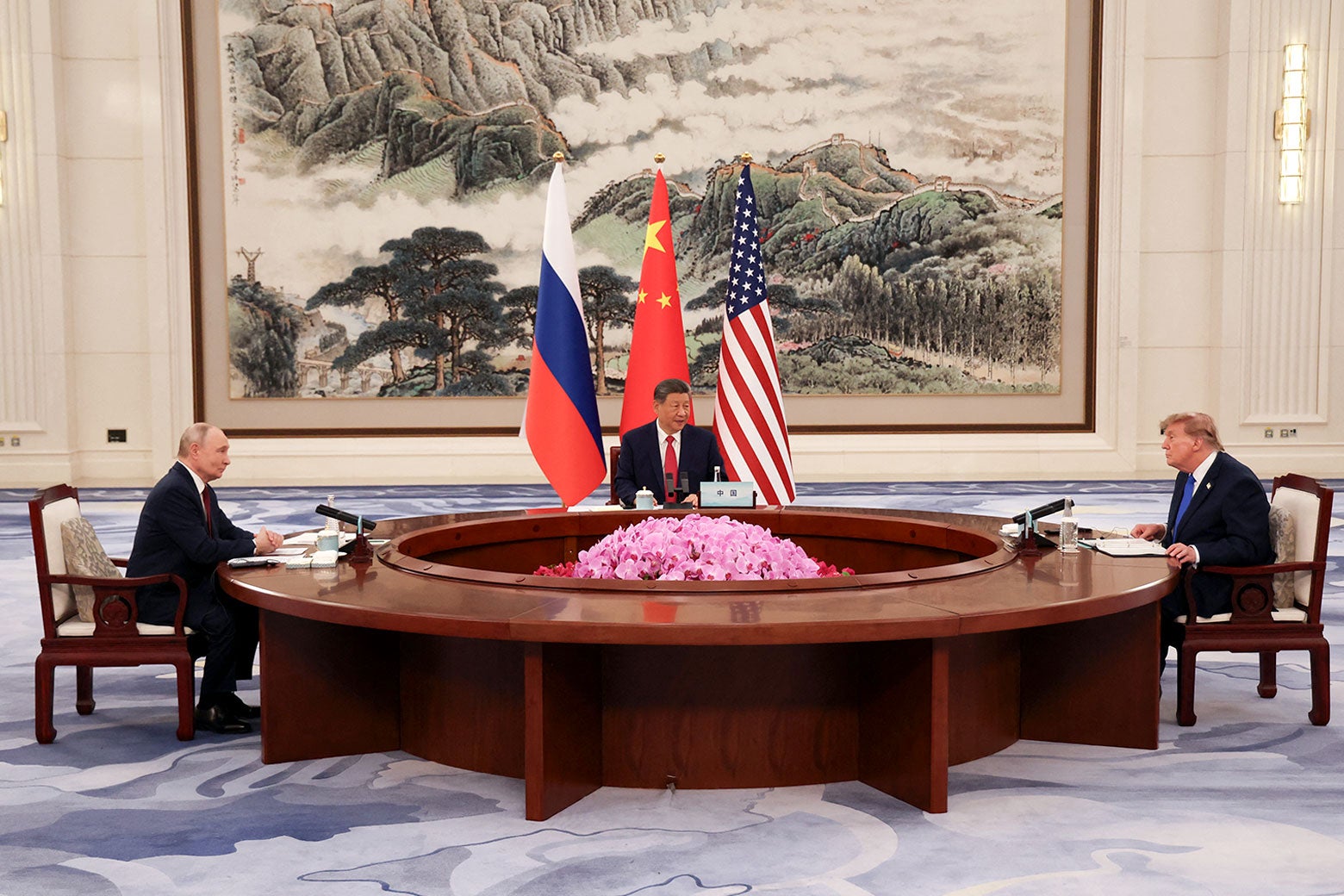
正如人们所预料的那样,唐纳德·特朗普、弗拉基米尔·普京和习近平出席的这场“历史性”峰会并未发生任何重要事件——这是美国、俄罗斯和中国领导人首次共同会面。
但别把这话告诉特朗普。他认为这次峰会具有极其重要的意义。在他抵达中国深圳后不久,习近平特意在机场隆重迎接他,这时有记者问他认为峰会将会产生怎样的“头条新闻”。
“我觉得我已经得到了那个头条。因为我和中国的关系非常好,”特朗普回答道。他还表示,习近平“从未到机场去迎接过任何人……这对我们来说是巨大的胜利。”就是这样。特朗普热衷于做作表演。问题在于他常常将做作表演误认为是现实。习近平在红毯上的问候——无论那是出于真诚的尊重还是为了迎合特朗普的自我意识——都是一种友善的姿态。但这并不能预示峰会所要探讨和解决的那些问题。特朗普并不明白这一点。对他而言,一切都是围绕唐纳德·J·特朗普展开的——不管别人是否喜欢他。其他所有世界领导人都意识到了这一点,因此,对于任何想从他那里得到什么的人来说,他都很容易被利用。
三位领导人是在亚太经济合作组织论坛结束时会面的。*正式的大国峰会通常会持续数小时,有时甚至数天。而特朗普、普京与习近平的峰会仅持续了一个半小时。这样的时间根本不足以发表开场白或听取翻译。在峰会后的声明中,他们宣布在四项问题上达成一致:联合国改革(未具体说明内容)、增加石油产量(并非具有远见之举)、进一步探讨降低核风险的问题(并未要求削减自身的核武器库),以及享有国际法院的管辖豁免权(这体现了他们对国际法的共同蔑视)。
换句话说,各方并未承诺就任何问题采取行动,甚至没有承诺进行系统性的对话。
普京和习近平都从这次活动中获得了好处。习近平举办了国际会议,随后得以以平等身份与世界上两个最大的核大国坐而论道。而普京仅通过出席此次会议,就摆脱了自近五年前入侵乌克兰以来一直困扰着他的“流亡者”地位,进而得以以平等身份与世界上两个最大的经济大国对话。另一方面,特朗普一无所获。在担任总统六年后,他犯了新手的错误——事先设定过高期望,希望讨论削减核武器以及结束乌克兰和伊朗的战争。但普京和习近平对这些问题毫无兴趣。
习近平希望继续扩充其核武器库,直至中国的核武器数量与美国和俄罗斯相当。普京在乌克兰轰炸克里米亚大桥后宣布暂停有关该战争的谈判(这其实也没什么大不了的,因为这些谈判从来都不认真)。习近平也不想谈论乌克兰问题,因为他长期以来一直在向俄罗斯提供武器技术并购买其石油。习近平和普京同样不想谈论伊朗战争,因为双方中的一方或双方一直在通过贸易、武器和情报方面为德黑兰提供帮助。特朗普参加峰会时并未制定明确的议程,且在伊朗的大规模轰炸行动失败以及其政党在中期选举中惨败之后,他已几乎没有任何筹码。他不得不将两位独裁者都称为“我的朋友”,甚至对普京说“能与您在一起是我的荣幸”,对习近平则说“能与您在一起是我的荣幸,总统先生”。
毫无疑问,特朗普回到华盛顿时面带笑容、意气风发,仅仅因为能坐在“三巨头”会议桌上,他的世界领袖地位就得到了再次确认。他可以无视——甚至用讥讽的态度否定——自己在最近的一次民主选举中遭到的挫败,而他的“好朋友”普京和习近平则无需忍受这种状况。许多处于特朗普这种境地的总统——那些所在政党刚刚失去国会控制权的“跛脚鸭”总统——都会将注意力转向外交政策,因为在这一领域他们有更大的操作空间。但至少他们中的大多数人都有明确的目标。特朗普却没有提出任何目标,而且只要他仍让贾里德·库什纳和史蒂夫·维特科夫担任他的全球事务特使,即便他有心实现目标,也不太可能做到。他将如何重启政策?他会展现出强硬态度,继续轰炸伊朗,因为他认为无法说服伊朗伊斯兰共和国的领导人签署符合他要求的协议吗?他会更加干脆地放弃基辅,以此帮助他的朋友弗拉基米尔恢复其势力范围吗?(针对欧洲人担心三方峰会会重演1945年的雅尔塔条约、从而为后续的冷战划分欧洲大陆的担忧,普京表示:“至于新的雅尔塔条约,雅尔塔条约到底有什么不好?”)他是否会通过对台湾命运表现出更强的冷漠态度,来对待他的朋友习?
《雅尔塔协定》确立了第二次世界大战结束时美、英、俄等盟军的力量格局。普京和习将此次会议视为又一个机会,以便从美国影响力下降的世界中获取利益,并在一定程度上分享这些利益。特朗普正在加速这一趋势。他在深圳的谄媚行为进一步凸显了这一动向,更糟糕的是,他显然没有意识到正在发生什么。
原文
As expected, nothing important happened at Thursday’s “historic” summit involving Presidents Donald Trump, Vladimir Putin, and Xi Jinping—the first time the leaders of the United States, Russia, and China have jointly met.
But don’t tell that to Trump. He thinks the summit had enormous significance. Shortly after his arrival in Shenzhen, China, where Xi took the unusual step of meeting him at the airport with great fanfare, a reporter asked him what he thought the “headline” coming out of the summit would be.
“I think I’ve already gotten that headline. Because the relationship that I have with China is a great one,” Trump replied. He added that Xi “has never gone to the airport to meet somebody. … That’s a big win for us.”
And there you have it. Trump is big on theatrics. The problem is that he often mistakes theatrics for reality. Xi’s greeting on the runway—whether a sign of genuine respect or an appeal to Trump’s ego—was a nice gesture. But it forecast nothing about the issues that summitry is meant to address and resolve. Trump doesn’t understand that. To him, everything is about Donald J. Trump—who seems to like him, who doesn’t. All the other world leaders recognize this, and as a result, he’s an easy mark for anyone who wants something from him.
The three leaders met at the end of the Asia-Pacific Economic Cooperation forum.* Serious big-power summits go on for many hours, sometimes days. The Trump-Putin-Xi summit lasted an hour and a half. That’s hardly enough time to make opening statements and hear the translations.
In a post-summit statement, they announced agreement on four items: reform of the United Nations (no specifics), an increase in oil production (not exactly forward-thinking), further dialogue on reducing nuclear risk (no requirement to reduce their own nuclear arsenals), and sovereign immunity from international courts (an expression of shared contempt for international law).
In other words, there was no commitment to take action, or even to hold systematic talks, on anything.
Putin and Xi got something out of the event. Xi played host to an international conference, then got to sit as an equal with the world’s two largest nuclear powers. By simply attending the conference, Putin ended his pariah status, which has plagued him since he invaded Ukraine nearly five years ago, and then got to sit as an equal with the world’s two largest economic powers.
Trump, on the other hand, got nothing. He made the rookie’s mistake—after being president for six years—of setting high expectations in advance, hoping to discuss nuclear arms reduction and an end to the wars in Ukraine and Iran. Putin and Xi had no interest in any of those subjects.
Xi wants to continue building up his nuclear weapons until China’s arsenal is as large as those of the U.S. and Russia. Putin announced that, after Ukraine’s bombing of the Crimea bridge, he is halting all negotiations about that war (no big deal, as those negotiations have never been serious). Xi didn’t want to talk about Ukraine either, as he has long been providing Russia with weapons technology and buying its oil. Nor did Xi or Putin want to talk about the Iran war, as one or the other or both have been helping Tehran with trade, weapons, and intelligence.
Trump came to the summit with no outlined agenda and—after the failure of his massive bombing campaign in Iran and the crushing defeat of his party in the midterm elections—very little leverage. He was reduced to addressing each of the two dictators as “my friend,” even saying, “It’s an honor to be with Vladimir” and, to Xi, “it’s an honor to be with you, Mr. President.”
Trump no doubt boarded the plane back to Washington beaming and pumped up, his status as world leader reaffirmed by his mere presence at the Big Three’s table, free to ignore—even to dismiss with a sneer—his recent repudiation in a democratic election, an imposition that his good friends Vladimir and Xi don’t need to put up with.
Many presidents in Trump’s position—lame ducks whose party just lost control of Congress—have turned their focus toward foreign policy, where they enjoy more leeway. But at least most of them had productive goals in mind. Trump hasn’t articulated any, and as long as he has Jared Kushner and Steve Witkoff as his global emissaries, he’s not likely to accomplish any, even if he did. How will he do the reboot? Will he flex his muscles and resume the bombing of Iran, realizing that he can’t cajole the Islamic Republic’s leaders to sign an agreement to his liking? Will he abandon Kyiv with an even more emphatic shrug, the better to help his friend Vladimir restore his sphere of influence? (Addressing the fear of Europeans that the trilateral summit might replicate the 1945 Yalta treaty, which divided up the continent for the subsequent Cold War, Putin said, “As far as a new Yalta goes, what was so bad about Yalta?”) Will he do the same for his friend Xi by hardening his indifference toward the fate of Taiwan?
The Yalta treaty formalized the positions of the Allied armies—the U.S., Britain, and Russia—at the end of World War II. Putin and Xi approached this meeting as another opportunity to reap, and to some extent share, the benefits of a world where American influence has declined. Trump is accelerating that decline. His fawning in Shenzhen further dramatized the trend, and, what’s worse, he clearly doesn’t see what’s going on.